
Bàdinjànli Pilàw
A fragrant Ottoman rice pilaf cooked with sliced aubergine, butter, and onions, delicately perfumed with saffron and gum-mastic. This 19th-century Turkish dish produces a richly flavoured, tender one-pot rice that is simple enough for beginners.
Ingredients
- 4 medium (3–4) egg-plants (aubergines) (Look for firm, glossy aubergines. These are labelled 'eggplant' in US/Australian stores and 'aubergine' in UK/Irish stores.)
- 340 grams (¾ lb) fresh butter (Use unsalted butter for best flavour control. This is a generous amount typical of Ottoman pilaf — it gives the rice richness and helps it cook without sticking.)
- 2 medium (1–2), finely chopped onions (Yellow or brown onions work well. Chop them as finely as you can so they soften evenly.)
- 1140 ml (2 pints / approximately 4¾ cups) water (Hot or cold water can be used — the original recipe allows either. Hot water will bring the pot to a boil slightly faster.)
- 570 ml (1 pint / approximately 2⅓ cups) broth (This is Broth No. 1 from the original book — a plain meat or chicken stock. Use a good-quality store-bought chicken or beef stock as a modern substitute. See inline broth steps below.)
- 1 to taste (a little) salt (Used in two places: first to scald the aubergine, then added with the liquids. Start with a small pinch each time and adjust.)
- 1 to taste (a little) black pepper (Freshly ground black pepper is best. Use a light hand — the original calls for just a little.)
- 1 a few small pieces gum-mastic (Gum-mastic (also called mastic or mastika) is a resin with a faintly piney, slightly sweet flavour. It is available in Middle Eastern, Greek, or specialist food shops, and online. It comes as small teardrop-shaped crystals — use 4–6 small pieces. It is optional if completely unavailable, but it is authentic and worth seeking out.)
- 1 small pinch (a small quantity) saffron (A small pinch of saffron threads is all you need. Crush them lightly between your fingers before adding for better colour and flavour release.)
- 680 grams (1½ lb / approximately 3½ cups uncooked) rice, well cleaned (The original calls for rice 'well cleaned', meaning thoroughly rinsed. Place the rice in a bowl, cover with cold water, swirl, then drain. Repeat 3–4 times until the water runs mostly clear. Long-grain white rice such as basmati works very well here.)
More recipes using Rice
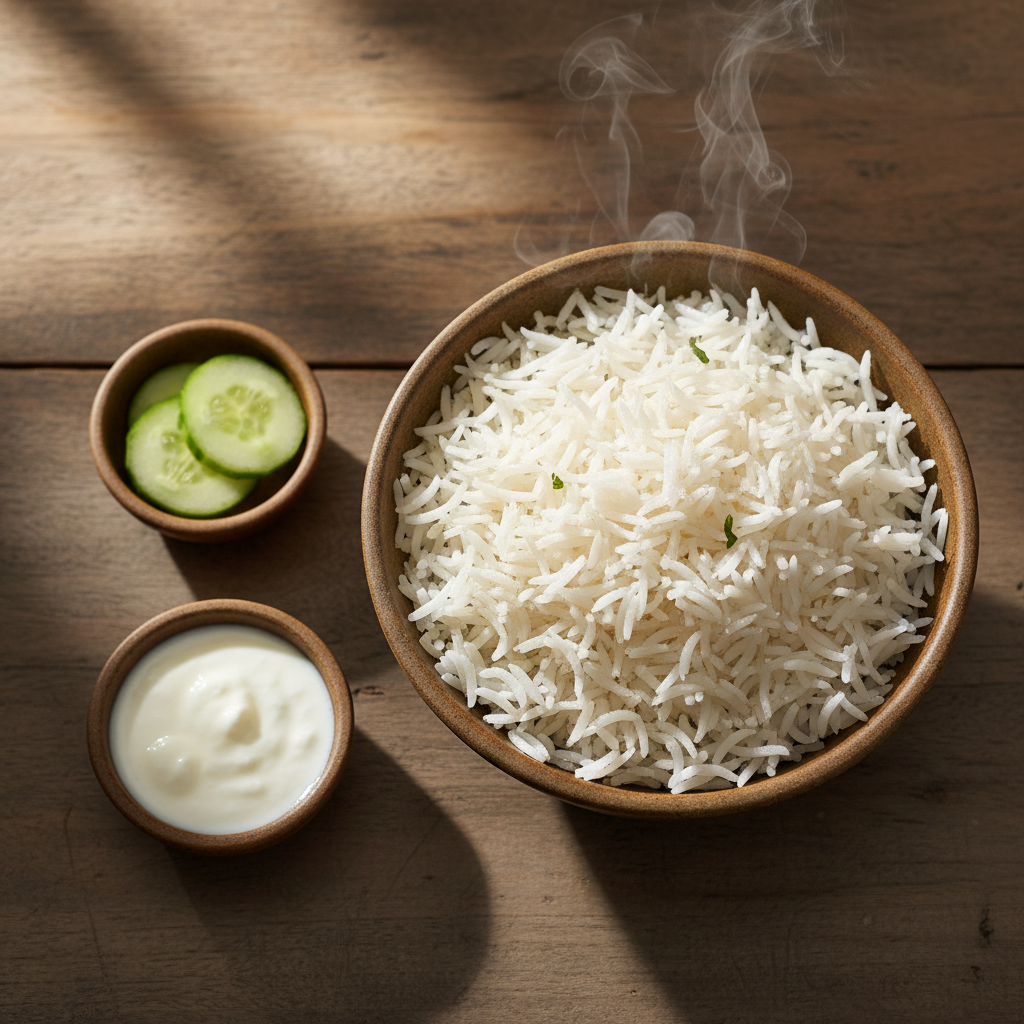
Boiled Rice (Bhath)
Traditional Indian method for cooking perfect boiled rice, suitable for breakfast, lunch, or dinner. This recipe uses high-quality long-grain rice varieties and produces fluffy, separate grains ideal for serving with curries and other dishes.

CHHANA POLAO
A fragrant layered rice and meat dish from colonial-era Indian cuisine, slow-cooked with aromatic spices, curd, and saffron. The meat is first boiled to create a flavourful stock (akhni water) used to cook the rice, building deep, complex layers of flavour.
Boiled Rice

LEFT OVER RICE
A simple and thrifty Chinese-style fried rice dish from 1927 that transforms leftover cooked rice and meat into a satisfying meal. Chopped meat or bacon is browned with onion, then combined with rice and fried until golden and crispy.
Instructions
- 1Take 3–4 firm aubergines (eggplants). Cut each one into four pieces crossways — meaning you slice across the width, not lengthways, producing thick rounds. If the pieces contain a lot of seeds inside, use a small spoon or your finger to scoop out the seedy flesh and discard it. Then cut each thick round into slices about 2.5 cm (1 inch) thick. You should end up with chunky, palm-sized pieces.
- 2Fill a medium saucepan with water and add a generous pinch of salt. Bring it to the boil over high heat. Add all the aubergine pieces and let them sit in the boiling salted water for 2–3 minutes — this is called 'scalding'. It softens the aubergine slightly and draws out any bitterness. After 2–3 minutes, pour the contents through a colander or sieve set in the sink, and leave the aubergine pieces to drain and cool for a few minutes. Do not rinse them.
- 3Place a large, wide heavy-bottomed saucepan or deep frying pan over a medium heat. Add all 340 g of fresh butter and let it melt completely. Once melted, add the 1–2 finely chopped onions. Stir to coat them in the butter. Let them cook gently, stirring occasionally, until they become soft and translucent — this takes about 8–10 minutes. You are aiming for them to turn 'nearly brown', meaning a light golden colour with some light browning at the edges. Do not let them go fully dark brown or crisp.
- 4Once the onions are nearly golden, add the drained aubergine pieces to the saucepan. Stir everything together so the aubergine pieces are coated in the buttery onions. Fry them together over a medium heat for about 5 minutes, turning occasionally, until the aubergine softens slightly and picks up some colour from the butter. They do not need to be completely cooked through at this stage — the original says 'partly' fried — as they will finish cooking with the rice.
- 5Pour in the 1,140 ml (2 pints) of water and the 570 ml (1 pint) of broth. Add a little salt and a little black pepper, lightly crushing the saffron threads between your fingers as you add them (this helps release their colour and aroma), and drop in the few small pieces of gum-mastic. Stir everything gently to combine. Turn the heat up to medium-high and bring the liquid to the boil. Watch the pot — this will take about 5–8 minutes.
- 6As soon as the liquid reaches a full boil, add the 680 g of rinsed rice. Stir once gently to distribute it evenly through the pot. Turn the heat down to low, so the liquid is at a slow, gentle simmer — just occasional small bubbles breaking the surface. Do not stir again. Put a lid on the saucepan and let it cook for 15–20 minutes, until the liquid has been fully absorbed by the rice and the surface looks dry with small steam holes appearing. The rice should be tender but not mushy. If there is still liquid after 20 minutes, leave the lid on and cook for a few more minutes.
- 7Once all the liquid has been absorbed, remove the saucepan from the direct heat and place it on the smallest burner set to the absolute lowest heat — or on a heat diffuser if you have one. This is the 'hob' resting step from the original recipe, which allows the rice to steam and finish cooking gently without burning. Leave it undisturbed for 10 minutes. If you do not have a second burner available, you can simply turn off the heat completely and leave the lid firmly on for 10 minutes — the residual heat will achieve the same result.
- 8After the 10-minute rest, remove the lid and use a large serving spoon or spatula to gently scoop the pilaf onto a large serving dish or platter. Try to keep some of the aubergine pieces visible on top for presentation. Serve immediately while hot. This pilaf is a complete dish on its own and needs no accompaniment, though it pairs naturally with yoghurt or a simple salad if desired.
You Might Also Like

Bàdinjàn Pàchassi
A classic Ottoman dish of flour-dusted aubergine slices fried in butter, then finished in a tangy garlic and wine vinegar sauce until the liquid is absorbed. Simple, bold, and deeply flavourful.

EGGPLANT FRIED IN OIL (TURKISH STYLE)
This Turkish-inspired eggplant dish offers a comforting and flavorful experience, perfect for a satisfying main course. The layers of tender eggplant, savory meat, and aromatic herbs create a rich and complex taste profile. The dish is baked until tender and infused with the flavors of olive oil and water, resulting in a delightful texture and taste.

Bàdingān Tùrshussu
A traditional Ottoman pickled aubergine recipe from 1864, in which split egg-plants are stuffed with chopped parsley, celery, and halved garlic cloves, tied with celery stalks, and preserved in wine vinegar for about three weeks. The result is a tangy, garlicky pickle with deep, complex flavour.

Mutton or Chicken with Eggplant
This traditional Parsi dish combines tender chunks of mutton or chicken with meltingly soft, seedless eggplants in a rich, savory gravy. The meat is slow-cooked with aromatic ginger, garlic, and fried onions until succulent, while the eggplants absorb the flavorful juices to create a harmonious texture. Enhanced with fresh herbs and a subtle sweet and sour finish from vinegar and sugar, this stew offers a perfect balance of flavors best enjoyed with rotis or crusty bread.