
Béchamel Sauce
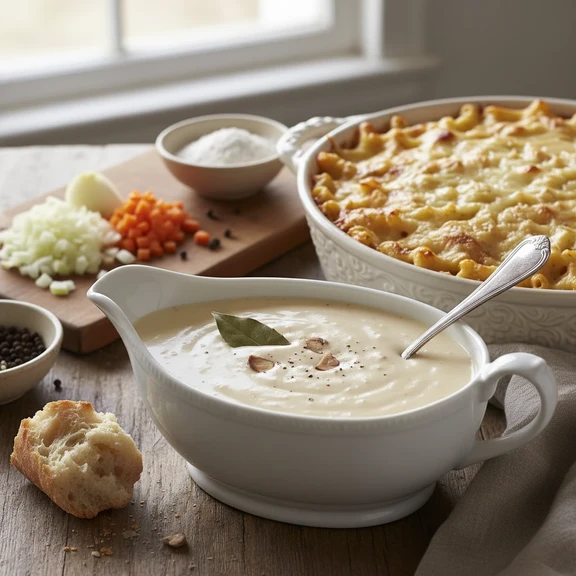
A rich, colonial-era Béchamel sauce built on a butter-and-flour base, simmered slowly with carrot, onion, mushrooms, and cream for a deeply flavoured, velvety result. Finished with an extra gill of cream for a luxuriously smooth texture just before serving.
Ingredients
- 0.25 lb (approximately 113g) preserved butter (such as "Cow-brand" or equivalent good-quality preserved butter) (Use the best quality preserved or clarified butter you can find. Regular unsalted butter works well as a modern substitute.)
- 1 medium, sliced into thin rounds carrot (Peel the carrot before slicing. Thin, even slices help it cook gently without browning.)
- 1 medium, sliced into thin rings onion (Peel and slice thinly. You want it to soften slowly, not colour or caramelise.)
- 2 oz (approximately 55g) plain flour (All-purpose plain flour. This will form the roux that thickens the sauce.)
- 0 quantity not specified — add gradually to reach a pourable consistency clear stock (Use a pale, clear chicken or veal stock. Add it gradually — enough to make the roux pourable and smooth before the cream goes in. Roughly 300–500ml is typical but add to your judgement.)
- 0.5 pint (approximately 285ml), for cooking cream (Double or heavy cream. This is the main cream added during cooking.)
- 1 small tin (approximately 200g drained tinned mushrooms, or equivalent fresh mushrooms finely chopped) mushrooms, chopped (The original recipe calls for a small tin of mushrooms. Use tinned mushrooms (drained and chopped) to stay true to the original, or use finely chopped fresh mushrooms.)
- 0 to taste salt (Add cautiously, especially if your stock is already salted.)
- 0 to taste pepper (White pepper is traditional in white sauces and won't add black specks, but black pepper works fine.)
- 1 gill (approximately 142ml), for finishing cream (This is stirred in just before serving to enrich and smooth the final sauce. Use double or heavy cream.)
Instructions
- 1Before you start cooking, peel and thinly slice the carrot into rounds and peel and thinly slice the onion into rings. Drain and roughly chop the tinned mushrooms if they are not already chopped. Measure out your butter, flour, and both quantities of cream and set them nearby. Having everything ready before you begin will make this sauce much easier to manage, as several steps require your continuous attention. Choose a medium, heavy-bottomed saucepan — this will distribute heat evenly and prevent the sauce from catching and burning.
- 2Place your heavy-bottomed saucepan over a low to medium-low heat. Add the 1/4 lb (approximately 113g) of preserved butter to the pan. Allow it to melt gently, swirling the pan occasionally. Do not let it brown — you want the butter fully melted and warm, but not sizzling or foaming heavily. A gentle, quiet melt is what you are after.
- 3Add the sliced carrot and sliced onion to the melted butter. Stir to coat them in the butter, then reduce the heat to low. Fry gently for 10 minutes, stirring occasionally. The key here is patience — you want the vegetables to soften and become translucent, but they must NOT take on any colour or start to brown. If the pan seems too hot, lower the heat further. The vegetables will release some moisture and become tender. This gentle sweating step builds a subtle, sweet flavour base for the sauce.
- 4Before the vegetables take on any colour — check that they are still pale — sprinkle the 2 oz (approximately 55g) of plain flour evenly over the butter and vegetables in the pan. Stir constantly with a wooden spoon, working the flour into the butter to form a paste (this is called a roux). Continue stirring over a low heat for 5 minutes. This step cooks out the raw flour taste. The mixture will look thick and slightly grainy — that is correct. Keep stirring to prevent it from sticking to the base of the pan.
- 5Now begin adding the clear stock a little at a time — a ladleful or a splash at a time — stirring vigorously after each addition to keep the sauce smooth and lump-free. Continue adding stock gradually until the mixture loosens into a pourable, thick sauce consistency. Once the stock is incorporated, pour in the 1/2 pint (approximately 285ml) of cream, add the chopped mushrooms, and season with salt and pepper to taste. Stir everything together well.
- 6Increase the heat to medium and stir the sauce continuously as it heats up. Keep stirring until the sauce comes to a full boil — you will see bubbles breaking across the entire surface. Stirring throughout this stage is important to prevent the sauce from scorching on the bottom of the pan and to ensure it thickens smoothly and evenly.
- 7Once the sauce has reached a boil, reduce the heat to its lowest setting so the sauce barely simmers — you should see only the occasional gentle bubble. Leave it to simmer slowly for one full hour. During this time, check it every 10–15 minutes and use a large spoon to skim off any fat or foam that rises to the surface. This long, slow simmer deepens the flavour considerably. Stir occasionally to make sure nothing is catching on the bottom.
- 8After the hour of simmering, remove the pan from the heat. Set a fine-mesh sieve or strainer over a clean saucepan. Pour the sauce through the sieve, pressing down gently with the back of a spoon to extract all the liquid from the vegetables and mushrooms. Discard the solids left in the sieve — they have done their work. To keep the strained sauce warm without it overcooking or forming a skin, place the clean saucepan inside a larger pan or bowl filled with hot (not boiling) water — this is a bain-marie, or water bath. The gentle indirect heat will keep the sauce warm and ready to serve without it thickening further or burning.
- 9Just before you are ready to serve the sauce, remove the saucepan from the bain-marie. Stir in the additional 1 gill (approximately 142ml) of cream. Stir gently until the cream is fully combined and the sauce is smooth and glossy. Taste and adjust the seasoning with a little more salt or pepper if needed. Serve immediately. The sauce should be pourable, velvety, and rich.
You Might Also Like

Bechamel Sauce (Two portions)
This classic Bechamel sauce, originating from a 1900 cookbook, is a rich and creamy base for many dishes. The sauce is made with simple ingredients like butter, flour, and milk, resulting in a smooth and velvety texture. It's a versatile sauce, perfect for serving with vegetables or as a base for other sauces.

Bechamel Sauce
This classic Bechamel Sauce recipe, dating back to 1900, offers a rich and creamy base for countless dishes. Made with simple ingredients like butter, flour, and cream, this sauce provides a delicate, buttery flavor. It's perfect for gratin dishes, casseroles, or as a base for other sauces.
Modern Bechamel Sauce
A classic white sauce, perfect for gratins, pasta dishes, and more. This modernized version provides clear instructions for a smooth and flavorful result.
Modern Bechamel Sauce
A classic white sauce, perfect for gratins, pasta dishes, and more. This modernized version of Bechamel Sauce No. 2 is easy to make and delivers a smooth, creamy texture.