
Béchamel
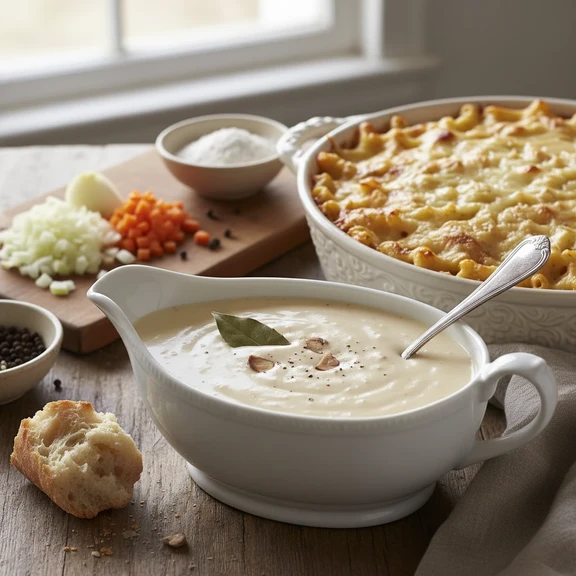
A rich, colonial-era Béchamel sauce built on a homemade clear consommé stock, gently enriched with cream, mushrooms, and preserved butter. This modernised version guides beginners through each stage, from making the base broth to finishing the sauce in a bain-marie.
Ingredients
- 1 portion (enough to make a pot of stock) meat and bones (Any bones or off-cuts suitable for making a clear broth. Ask your butcher for soup bones if unsure.)
- 1 enough to cover the meat and bones water (Use cold water to start; this helps produce a clearer broth.)
- 1 pinch powdered sugar (plain) (Used in place of burnt sugar colouring to very lightly sweeten and clarify the broth. Do not add more than a pinch.)
- 0.25 pound (approximately 115g) preserved butter (such as Cow-brand or any good quality clarified/preserved butter) (The original calls for 'Cow-brand' preserved butter. Clarified butter or ghee is an appropriate modern equivalent if preserved butter is unavailable.)
- 1 medium, sliced into thin rounds carrot (Peel and slice thinly so it softens evenly during frying.)
- 1 medium, sliced into thin rings or half-moons onion (Slice evenly so it cooks at the same rate as the carrot.)
- 2 ounces (approximately 55g) plain flour (This is stirred into the butter and vegetables to form a roux, which thickens the sauce.)
- 1 sufficient quantity to build the sauce (see instructions) clear stock (consommé made in step 1–3) (This is the strained broth produced in the first stage of the recipe. Add it gradually so the sauce stays smooth.)
- 0.5 pint (approximately 285ml) cream (Added during the main sauce-building stage. Single or double cream both work.)
- 1 small tin mushrooms, chopped (tinned) (The original specifies a small tin of mushrooms. Drain and chop them before adding.)
- 1 to taste salt (Season carefully, as the stock may already carry some saltiness.)
- 1 to taste pepper (White pepper is traditional for a pale sauce, but black pepper works too.)
- 1 gill (approximately 142ml) cream (This final addition of cream is stirred in just before serving, giving the sauce an extra richness and gloss.)
Instructions
- 1Place your meat and bones into a large, heavy-bottomed saucepan or stockpot. Pour over enough cold water to fully cover them. Do not brown the meat or bones first — the goal here is a pale, clear broth, so skip any roasting or caramelising step. Starting with cold water helps draw out impurities gradually, which makes skimming easier later.
- 2Place the pot over a medium heat and bring the water slowly up to a gentle simmer. As it heats, you will see grey or white foam rising to the surface — this is normal. Skim it off carefully with a large spoon or ladle and discard it. Once the liquid is simmering and fairly clear of foam, add a small pinch of powdered sugar. This replaces the traditional burnt sugar colouring and helps keep the broth pale and lightly flavoured rather than dark.
- 3Continue to simmer the broth gently, skimming away any fat or foam that rises to the surface as you go. The liquid should remain at a very gentle simmer — not a rolling boil — to keep it clear. Once you are satisfied the broth is as clear as possible and well-flavoured (this may take 20–30 minutes of gentle simmering), carefully pour it through a fine-mesh sieve or a sieve lined with a piece of clean cloth into a clean bowl or jug. Discard the solids. You should now have a clear, pale broth — set this aside and keep it warm, ready to use shortly.
- 4Take a medium saucepan and place it over a low to medium heat. Add the quarter pound (approximately 115g) of preserved butter. Allow it to melt gently — do not let it brown or smoke. Swirl the pan occasionally to help it melt evenly. Once fully melted and hot, you are ready to fry the vegetables.
- 5Add the sliced carrot and sliced onion to the melted butter. Stir to coat them in the butter and spread them out in the pan. Fry gently over a low to medium heat for ten minutes, stirring occasionally. The key here is that they must NOT take on any colour or browning — you want them to soften and become translucent, not caramelise. If they begin to colour, reduce the heat immediately.
- 6Before the vegetables take on any colour, add the two ounces (approximately 55g) of plain flour directly into the pan. Stir continuously and vigorously with a wooden spoon or spatula, making sure the flour is fully absorbed into the butter and coats the vegetables evenly. Keep stirring over a low to medium heat for five minutes. This cooks out the raw flour taste and forms the base (roux) that will thicken your sauce. The mixture should look pale and slightly sandy — again, do not let it colour or brown.
- 7Now begin adding your strained clear stock from step 3 — do this gradually, a ladleful at a time, stirring well after each addition to keep the sauce smooth and lump-free. Once the stock is incorporated, pour in the half pint (approximately 285ml) of cream, again stirring as you go. Add the drained and chopped tinned mushrooms. Season with salt and pepper to taste. Stir everything together well to combine.
- 8Increase the heat to medium and stir the sauce continuously until it comes to a boil — you will see large bubbles beginning to form and the sauce will thicken noticeably. Once boiling, immediately reduce the heat to the lowest setting so the sauce simmers very gently. Allow it to simmer slowly for one full hour. During this time, check on it regularly and use a spoon to skim off any fat or oily film that rises to the surface. Stir occasionally to prevent the sauce from sticking to the bottom of the pan.
- 9After the hour of simmering, your sauce will be thick, creamy, and fragrant. Pour it carefully through a fine-mesh sieve into a clean saucepan, pressing lightly on the solids to extract all the sauce. Discard the strained vegetable and mushroom solids. To keep the sauce warm without it overcooking or forming a skin, place the saucepan into a bain-marie: set it inside a larger pan or bowl of hot (not boiling) water. This gentle, indirect heat will keep the sauce at the right temperature until you are ready to serve. Stir occasionally.
- 10Just before you are ready to serve the Béchamel, lift the saucepan out of the bain-marie. Pour in the gill (approximately 142ml) of cream and stir it gently but thoroughly into the sauce. This final addition gives the sauce a beautiful gloss and extra richness. Taste once more for seasoning, then serve immediately while hot and smooth.
You Might Also Like

Bechamel Sauce
This classic Bechamel Sauce recipe, dating back to 1900, offers a rich and creamy base for countless dishes. Made with simple ingredients like butter, flour, and cream, this sauce provides a delicate, buttery flavor. It's perfect for gratin dishes, casseroles, or as a base for other sauces.
Modern Bechamel Sauce
A classic white sauce, perfect for gratins, pasta dishes, and more. This modernized version provides clear instructions for a smooth and flavorful result.
Modern Bechamel Sauce
A classic white sauce, perfect for gratins, pasta dishes, and more. This modernized version provides clear instructions for beginners.

Bechamel Sauce (Two portions)
This classic Bechamel sauce, originating from a 1900 cookbook, is a rich and creamy base for many dishes. The sauce is made with simple ingredients like butter, flour, and milk, resulting in a smooth and velvety texture. It's a versatile sauce, perfect for serving with vegetables or as a base for other sauces.