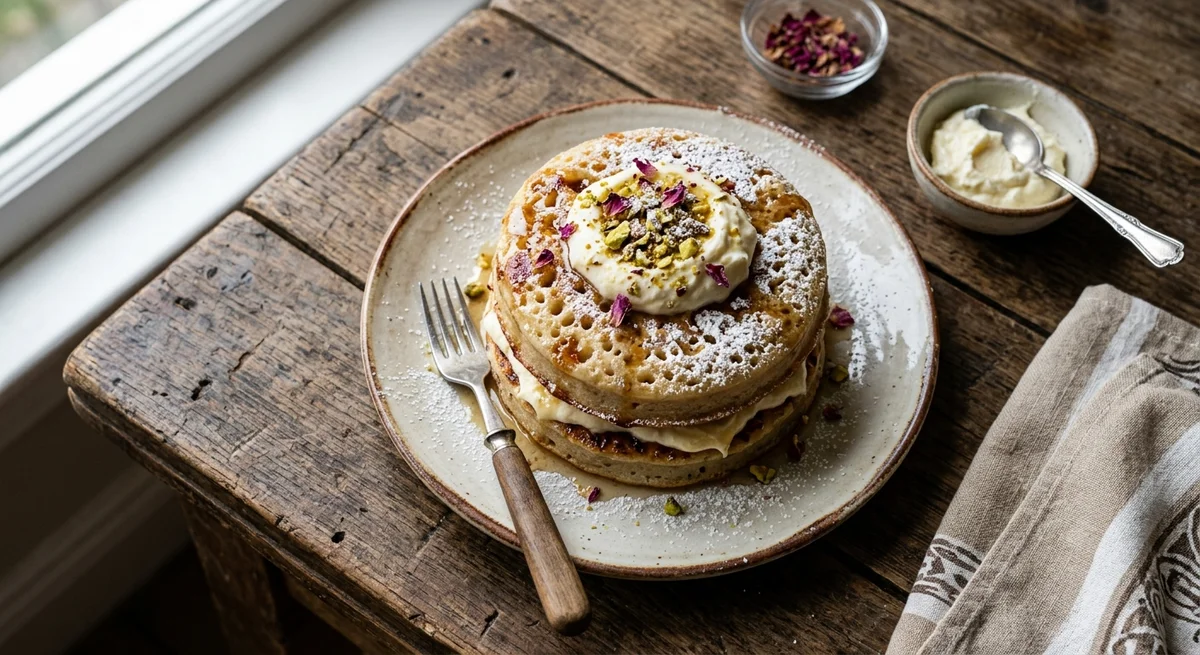
Jizlèmè
Jizlèmè is a traditional Ottoman hot sweet pastry made from yeast-leavened crumpets layered with clotted cream, powdered sugar, and a warm butter-sugar syrup, finished with a delicate splash of rose water. It is a comforting, lightly fragrant dessert from the 1864 Turkish Cookery Book by Turabi Effendi.
Ingredients
- 450 grams (1 pound) best plain flour (Use a high-quality plain (all-purpose) flour for best results.)
- 0.5 teaspoon salt (Fine table salt works well here.)
- 7 grams (a very small piece, roughly 1/4 oz) German yeast (fresh yeast) (German yeast refers to fresh (compressed) baker's yeast. If unavailable, use 3.5g (1 teaspoon) of active dried yeast as a substitute. Activate dried yeast in a little warm water before using.)
- 300 ml (approximately), lukewarm water (for dough) (Add gradually — the dough should be pourable but thick, like a thick pancake batter. The water should be lukewarm (about 37°C / 98°F) to activate the yeast.)
- 150 grams (approximately, for layering) clotted cream (Spread a thin layer between each crumpet. Use a good-quality clotted cream. If unavailable, thick double (heavy) cream can be used.)
- 2 tablespoons (approximately, for layering between crumpets) powdered sugar (for layering) (Also known as icing sugar or confectioners' sugar. Sprinkle lightly between each layer.)
- 340 grams (three-quarters of a pound) sugar (for syrup) (Plain white granulated sugar.)
- 570 ml (1 pint) water (for syrup) (Cold or room-temperature water is fine.)
- 85 grams (three ounces) fresh butter (Unsalted butter is ideal. Cut into pieces for easier melting.)
- 1 tablespoon (approximately, to sprinkle) rose water (Use culinary-grade rose water. A light sprinkle is all that is needed — it is very fragrant.)
Instructions
- 1Into a large mixing bowl, measure out 450g (1 pound) of flour. Add half a teaspoon of salt and the small piece of fresh yeast (about 7g). If using dried yeast, first dissolve it in a few tablespoons of the lukewarm water and let it sit for 5 minutes until foamy before adding. Gradually pour in lukewarm water (around 37°C / 98°F), stirring constantly with a wooden spoon or whisk, until you have a smooth, pourable batter — thicker than pancake batter but still pourable, similar to a crumpet batter. You may not need all the water, so add it slowly. The batter should fall off the spoon in a thick ribbon.
- 2Cover the bowl tightly with a clean damp tea towel or cling film (plastic wrap). Place the bowl in a warm spot — for example, near a warm oven, in a turned-off oven with just the light on, or in a warm room (around 25–30°C / 77–86°F). Leave the dough to rest and rise for approximately 1 to 1.5 hours, or until it has roughly doubled in volume and looks bubbly and airy. This rising time allows the yeast to work and creates a light, open texture in the finished crumpets. Do not rush this step.
- 3Place a large, flat non-stick frying pan or griddle over a medium-low heat and allow it to warm up for 1–2 minutes. Lightly grease it with a tiny amount of butter if needed. Pour a ladleful of the risen batter into the centre of the pan, spreading it gently with the back of the ladle to form a round about 25–28cm (the size of a dinner plate) in diameter and as thin as possible — roughly 2–3mm thick (about as thick as a pound coin, which is the modern equivalent of a 'crown-piece'). Cook until the surface looks set and dry (about 2–3 minutes), then carefully flip with a wide spatula and cook for a further 1–2 minutes on the other side until lightly golden. Remove and set aside on a plate. Repeat with the remaining batter to make 5 to 6 crumpets in total.
- 4Take a deep, round baking dish or cake tin (approximately 28–30cm diameter). Place the first crumpet flat in the bottom of the tin. Spread a thin, even layer of clotted cream over the top surface, then sprinkle a small amount of powdered sugar lightly over the cream. Place the next crumpet directly on top and repeat — cream, then powdered sugar. Continue stacking and layering until all 5 or 6 crumpets are used. Do not add cream or sugar to the top of the final (topmost) crumpet, as the syrup will be poured over it.
- 5In a medium saucepan, combine 340g (three-quarters of a pound) of sugar with 570ml (1 pint) of water. Place the saucepan over a medium heat and stir with a wooden spoon until the sugar has fully dissolved. Add 85g (three ounces) of butter, cut into small pieces, to the pan. Continue to stir constantly over a medium heat until all the butter has melted completely and is incorporated into the syrup. Do not allow the mixture to boil vigorously — keep it at a gentle simmer and stir throughout. Once the butter is fully melted, remove the pan from the heat.
- 6Carefully and slowly pour the warm butter-sugar syrup evenly over the top of the stacked crumpets in the baking tin. Pour it in a slow, steady stream, moving around the tin to ensure it spreads evenly and begins to soak down through the layers. Allow the syrup a minute to start soaking in before moving the tin.
- 7Preheat your oven to 150°C (300°F / Gas Mark 2) — this is a very gentle, low heat, equivalent to the original 'very slow charcoal fire'. Place the baking tin carefully in the oven and bake for 10 to 15 minutes. The goal is simply to heat the dish through, allow the syrup to fully soak into all the layers, and warm the cream gently. Do not bake at a higher temperature or for longer than 15 minutes, as the cream can split.
- 8Using oven mitts, carefully remove the baking tin from the oven. To serve, gently slide a wide spatula or flat server under the stack and lift it carefully onto a serving plate, keeping the layers intact as best you can — or serve directly from the tin. Sprinkle a tablespoon of rose water lightly and evenly over the top of the warm crumpet stack. Serve immediately while warm. The dish is best eaten fresh.