PROLEHA
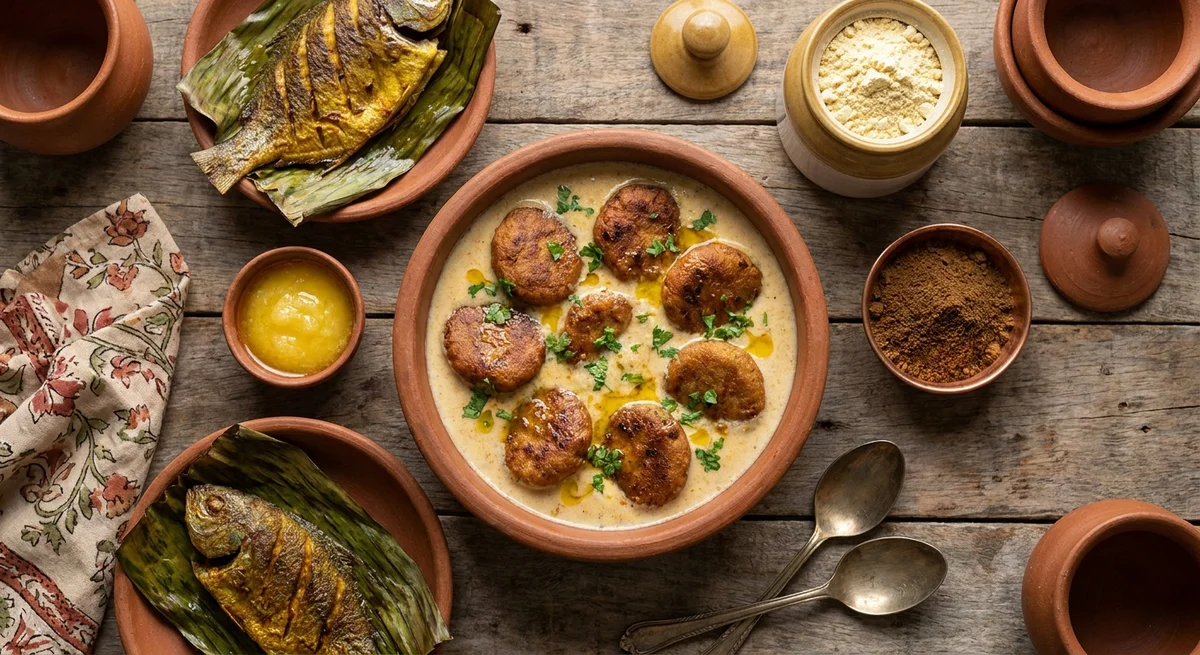
Proleha is a traditional Bengali fish preparation where whole fish is clay-baked, deboned, and formed into spiced gram flour cakes that are then browned in ghee and simmered in a fragrant curd-based curry sauce. It is described in the original source as costly and laborious but an excellent Bengali dish.
Ingredients
- 1 whole fish (approximately 1 to 1¼ seers, roughly 900g–1.1kg) whole fish (Any firm whole fish suitable for Bengali cooking. The fish should be intact before preparation begins.)
- 1 powa (approximately 233ml or about 200g) ghee (Clarified butter. Used in multiple stages of the recipe.)
- 1 powa (approximately 233ml or about 100g) besam (chickpea flour / gram flour) (Also known as besan or gram flour. Used to bind the fish cakes.)
- 0.5 tola (approximately 6g) garam masala (powdered) (Pre-ground garam masala. Used in two stages: mixing into the fish cakes and finishing the dish.)
- 1 tola (approximately 12g) black pepper (powdered) (Grind whole black peppercorns to a powder if not already ground.)
- 2 tolas (approximately 24g) coriander (powdered) (Grind whole coriander seeds to a powder if not already ground.)
- 0.5 powa (approximately 116ml or about 120g) curd (plain yoghurt) (Plain, unsweetened yoghurt. Added to the sauce.)
- 2 tolas (approximately 24g) salt (Added to the sauce. Adjust to taste.)
- 1 small handful (a few leaves) cassia leaves (tej patta / Indian bay leaves) (These are Indian bay leaves, distinct from Mediterranean bay leaves. Use 4–6 leaves.)
- 1 small pinch (to taste) cloves (Whole cloves, quantity not specified in the original. Use 4–6 whole cloves.)
- 1 small pinch (to taste) panch foron (Bengali five-spice blend) (A Bengali whole-spice blend typically containing fenugreek, nigella, cumin, black mustard, and fennel seeds. Quantity not specified in the original.)
- 1 small handful (to taste) almonds (Quantity not specified in the original. Whole or roughly chopped. Added near the end of cooking.)
- 1 small amount (a little, to taste) plain flour (Used to thicken the sauce slightly. Quantity not specified in the original; use just enough to gently thicken.)
- 1 sufficient to fill the pan for steaming and sauce water (Used in two stages: for steaming the fish cakes on banana leaves, and added to the sauce.)
- 1 enough to line the bottom of the pan banana leaves (Used to line the pan during the steaming of the fish cakes. Can be sourced from Asian grocery stores.)
Instructions
- 1Scale, gut, and clean the whole fish thoroughly. Remove the fins and intestines. Rinse the fish well under cold running water. Pat it dry with a clean cloth. The fish should remain whole at this stage — do not cut it open further than necessary to remove the innards. Beginners' tip: Ask your fishmonger to gut and clean the fish for you if this step feels daunting.
- 2Wrap the cleaned whole fish tightly in a piece of clean, undyed linen cloth. Once wrapped, coat the outside of the linen completely with a thick, even layer of moist clay, covering every surface. This traditional technique seals the fish for clay-baking, trapping moisture and flavour inside. Make sure the clay layer is thick enough (at least 1–2 cm) so it does not crack open during cooking. Beginners' tip: Natural potters' clay or clean garden clay can be used. Ensure the clay is free of any impurities. Wet it to a thick, mouldable consistency before applying.
- 3Place a large, heavy-bottomed pan or pot on the stove. Pour a deep layer of dry sand into the pan, enough to partially bury and support the clay-wrapped fish. Place the clay-wrapped fish on top of the sand. Cover the pan with a lid. Heat on a medium-high flame. The sand distributes the heat evenly around the clay parcel, gently cooking the fish inside without burning it. Cook for approximately 45–60 minutes, turning the clay parcel occasionally if possible. The clay will harden and turn light in colour when the fish is cooked through. Beginners' tip: This is the traditional method. The sand acts like an oven, radiating indirect heat. Keep a steady medium-high flame and be patient.
- 4Once the clay has hardened and cooled slightly (allow 10 minutes to cool before handling), carefully crack open and remove all the clay. Unwrap and discard the linen. Rinse the fish gently under cold water to remove any remaining clay or debris. Now carefully remove all the bones from the fish — work methodically from the spine outward, checking for small pin bones as well. Place the cleaned fish flesh in a large bowl. Add the gram flour (besam) and the powdered garam masala. Mix thoroughly by hand until the fish and flour are fully combined into a firm, workable mixture. Shape the mixture into small, round cakes — about the size of a golf ball or slightly larger. Place them on a clean plate. Beginners' tip: Wetting your hands slightly makes shaping the cakes easier and prevents sticking.
- 5Take a wide, deep pan. Line the bottom of the pan completely with banana leaves. Pour in enough water to just reach the level of the banana leaves without submerging them — the leaves act as a natural mat to keep the cakes off the base of the pan. Carefully place the fish cakes on top of the banana leaves in a single layer. Do not overcrowd them. Bring the water to a gentle boil over medium heat. Cover the pan with a lid and allow the cakes to steam-boil for approximately 10–15 minutes, until the outsides of the cakes feel slightly firm to the touch. Do not over-cook — they should hold their shape but remain moist inside. Remove the cakes carefully using a spatula and set aside. Beginners' tip: If banana leaves are unavailable, you may line the pan with baking parchment, though this departs from the traditional method.
- 6In a large, heavy-bottomed pan or kadhai, heat the ghee over medium heat. Once the ghee is hot and shimmering, add the cassia leaves (Indian bay leaves), cloves, and panch foron. Stir gently and allow the whole spices to sizzle and become fragrant — this should take about 1–2 minutes. Do not let them burn. Carefully lower the steamed fish cakes into the spiced ghee. Brown them on all sides, turning gently with a spatula, until they develop a golden-brown crust. This should take approximately 5–8 minutes. Remove the browned cakes carefully and set aside on a plate. Leave the spiced ghee and aromatics in the pan for the next step. Beginners' tip: Work in batches if needed to avoid overcrowding the pan, which would cause the cakes to steam rather than brown.
- 7In the same pan with the remaining spiced ghee, add salt, a splash of water (enough to create a sauce that will loosely coat the cakes — roughly 200–300ml as a guide, since the original gives no exact quantity), the curd, powdered coriander, and powdered pepper. Stir everything together well, scraping up any browned bits from the bottom of the pan. Return the browned fish cakes to the pan. Bring the sauce to a gentle boil over medium heat, then reduce the heat to low. Simmer for 5–8 minutes, allowing the cakes to absorb the flavours of the sauce. Stir gently occasionally to avoid the cakes breaking apart. Beginners' tip: Whisk the curd before adding it to prevent it from splitting in the hot pan.
- 8Once the sauce has come to a boil and is simmering, add the almonds and a little plain flour. Stir gently to incorporate the flour into the sauce — it will help to thicken it slightly. Continue to simmer for a further 3–5 minutes until the sauce reaches a slightly thicker, coating consistency. Beginners' tip: To avoid flour lumps, mix the flour with a small amount of cold water first to make a thin paste, then stir this paste into the simmering sauce gradually.
- 9Remove the pan from the heat. Drizzle over a final addition of ghee and sprinkle with powdered garam masala. Stir gently to combine. The residual heat of the dish will bloom the spices without overcooking them. Serve immediately. This is a rich, aromatic Bengali curry best enjoyed with steamed rice or flatbread. Beginners' tip: The final addition of ghee and garam masala is a classic finishing technique in Indian cooking — it adds a fresh layer of aroma and richness just before serving.