
BARFI of COCOA-NUT
A traditional Indian confection made from half-ripe coconut paste and khowa kheer, sweetened with sugar syrup and fragrant with cardamom. The mixture is cooked until thick and set into firm cubes — a simple, delicate sweet with a chewy, fudge-like texture.
Ingredients
- 0 a few (enough to yield approximately 470 g / 1 lb of paste) half-ripe coconut kernels (Half-ripe coconuts have a softer, jelly-like flesh that is easy to scrape and paste. Modern equivalent: look for young-but-firming coconuts at Asian grocery stores. Avoid fully mature hard coconuts for this recipe.)
- 470 g (approximately 2 cups), equivalent to 1/2 seer coconut paste (scraped from half-ripe kernels, prepared in Step 1) (1 seer is a historical South Asian unit equal to approximately 933 g (about 2 lb). Half a seer is approximately 470 g. This paste is made in Step 1 — only half the total paste made is used in the recipe.)
- 470 g (approximately 2 cups), equivalent to 1/2 seer khowa kheer (milk solids / mawa) (Khowa kheer (also spelled khoya or mawa) is a dense, dough-like dairy product made by slowly simmering milk until all moisture evaporates. It is available at Indian grocery stores. If unavailable, use unsweetened full-fat ricotta as an approximate substitute, though texture may differ slightly.)
- 11.6 g (approximately 1 tablespoon), equivalent to 1 tola powdered cardamom (1 tola is a historical South Asian unit equal to approximately 11.6 g. Use pre-ground cardamom or grind green cardamom seeds yourself for the freshest flavour.)
- 933 g (approximately 4 and 2/3 cups), equivalent to 1 seer sugar (Used to make a sugar syrup in Step 3. White granulated sugar is ideal.)
More recipes using Coconut

Coconut Chikki
This traditional sweet transforms fresh coconut into a crisp, golden brittle by meticulously removing the milk and dry-roasting the shreds to concentrate their flavor. The prepared coconut is folded into a rich, caramelized jaggery syrup, creating a confection that balances the chewy texture of the nut with the snap of hard candy. Perfect for festivals or as a tea-time snack, this chikki offers a deep, earthy sweetness with a delightful crunch in every bite.

Batasa-like Kopra Pak (White Coconut Fudge)
This unique Parsi-Gujarati sweet transforms simple coconut and sugar into a delicate, porous confection resembling "Batasa" (sugar meringues). Unlike standard dense fudges, this version requires vigorous stirring to aerate the mixture, resulting in a pure white, net-like texture that is crisp at the bottom and airy throughout. It is flavored simply with rose water and cardamom to let the fresh coconut shine, making it an elegant treat for special occasions.

Kopranpak (Fresh Coconut Fudge)
This traditional Gujarati sweet, known as Kopranpak, transforms fresh, juicy coconut into a rich and aromatic fudge. The recipe calls for grating only the pristine white flesh of the coconut and cooking it with sugar until it reaches a perfect, chewy consistency, infused with the floral notes of rose water and warm cardamom. Finished with a garnish of slivered almonds, these diamond-shaped treats offer a delightful texture that is both soft and slightly crisp, making them perfect for festive occasions.

Dry Coconut Fudge (Koprapak)
This traditional Gujarati sweet is a rich, fudge-like confection made from a luxurious blend of finely grated dry coconut, fresh mava (milk solids), and ground almonds. The addition of fresh coconut milk and aromatic spices like cardamom, nutmeg, and rose water creates a decadent texture that is both chewy and melt-in-the-mouth. Perfect for festivals, this dense, golden treat is set in diamond shapes and offers a delightful balance of nutty and milky flavors.
Instructions
- 1Take a few half-ripe coconut kernels. Using a spoon or coconut scraper, scrape out the soft flesh from inside each coconut half. Transfer the scraped flesh to a blender or food processor and blend until you have a smooth, thick paste. You will need approximately 470 g (about 2 cups / half a seer) of this paste for the recipe, so scrape enough coconuts to yield at least that amount. Set the measured paste aside.
- 2Before you begin cooking the main mixture, prepare the sugar syrup. Place 933 g (approximately 4 and 2/3 cups) of sugar in a medium saucepan. Add just enough water to cover the sugar — approximately 240 ml (1 cup) — and stir to combine. Place the pan over medium heat and stir until the sugar fully dissolves. Once dissolved, stop stirring and let the syrup simmer until it reaches a one-string consistency: dip a clean spoon into the syrup, let it cool for a moment, then touch it between your thumb and index finger and pull apart slowly — a single thin thread should form. Remove from heat and set aside. This should take approximately 10–15 minutes.
- 3Place a heavy-bottomed pan or non-stick frying pan over medium heat. Add the 470 g of coconut paste and 470 g of khowa kheer (mawa) directly to the dry pan — do not add any ghee, butter, or oil. Stir the mixture continuously with a wooden spoon or spatula, pressing and turning it against the base of the pan. Cook for approximately 5–8 minutes, until the mixture is warmed through, slightly drier, and begins to come together. It should not brown — keep the heat at medium and stir constantly to prevent sticking or burning.
- 4With the pan still on medium heat, add 11.6 g (approximately 1 tablespoon) of powdered cardamom and pour in the prepared sugar syrup from Step 2. Stir everything together immediately to combine. Continue to stir the mixture constantly, scraping the bottom and sides of the pan to prevent burning. Cook for approximately 15–20 minutes, until the mixture becomes very thick, glossy, and pulls away from the sides of the pan into a cohesive, gluey mass. It should be stiff enough that a spoon dragged through it leaves a clear path that is slow to close. Reduce heat to low toward the end if needed to avoid scorching.
- 5Remove the pan from the heat. Immediately pour and scrape the thick mixture onto a large flat plate or a greased shallow tray, spreading it out evenly with the back of a spoon or a spatula to a uniform thickness of approximately 1.5–2 cm (about 3/4 inch). Work quickly as the mixture will begin to firm up as it cools. Allow the barfi to cool completely at room temperature — this will take approximately 45–60 minutes. Do not refrigerate at this stage, as slow cooling helps it set evenly.
- 6Once the barfi is completely cold and firm to the touch, use a sharp knife to cut it into small cubes or rectangles of your preferred size — approximately 3 cm x 3 cm (about 1 inch x 1 inch) is traditional. Cut with a single downward press rather than sawing, to get clean edges. The barfi is now ready to serve. Store any leftovers in an airtight container at room temperature for up to 2 days, or refrigerate for up to 5 days.
You Might Also Like
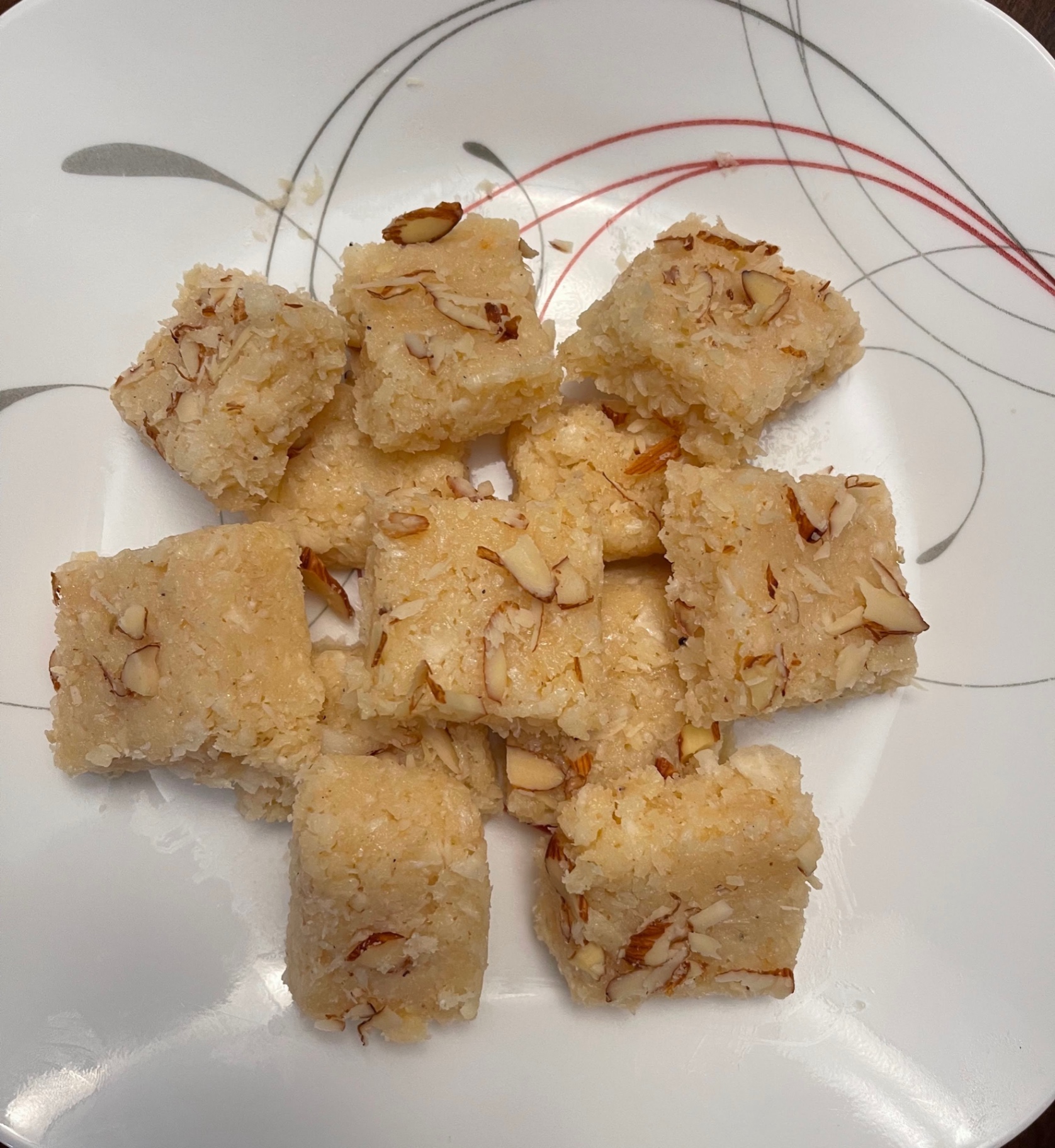
Coconut Barfi
A quick and easy delicious dessert recipe with coconut.
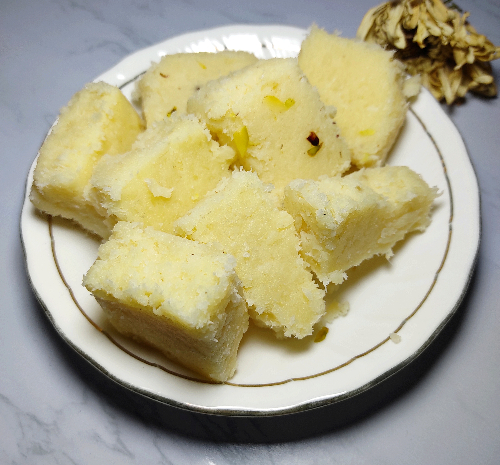
Nariyal Burfi / Coconut Sweet
Delicious sweet with coconut recipe

BARFI of ALMONDS
A rich, traditional Indian confection made from ground almonds cooked with khowa kheer, sugar syrup, and fragrant cardamom in ghee. The mixture is set on a greased plate and cut into firm, sweet cubes.
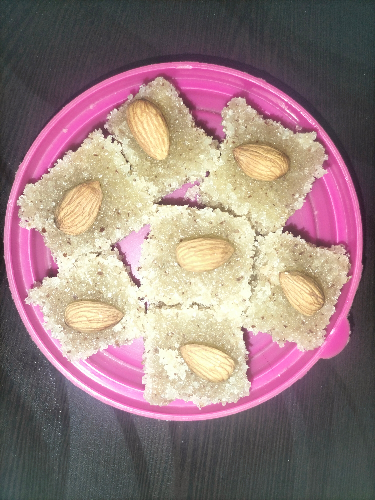
Coconut Burfi
Coconut Burfi is a sweet, which is very simple and easy to make.